
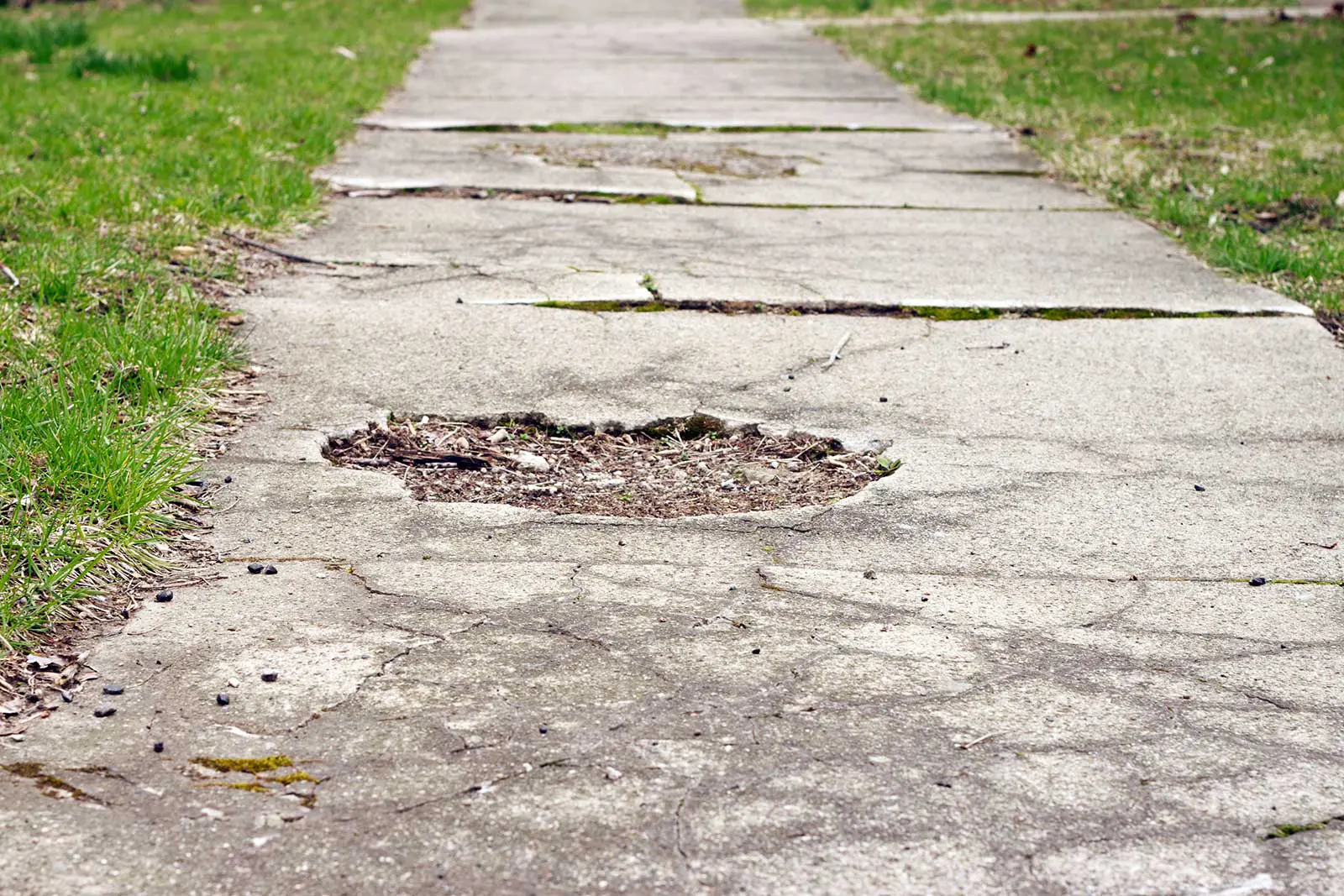
Before anything else, a trip and fall case turns on a question most people never think to ask: who was actually responsible for that stretch of pavement? On Long Island the answer changes from one village to the next.
Attorney Jordan Stern handles your case personally, from the first call through the resolution. He has represented injured New Yorkers for over 30 years, across Nassau and Suffolk County, from the firm's office in Freeport.
Free consultation. No fee unless we recover money for you.
Who is responsible for the sidewalk where I fell?
This is the first question in the case, and on Long Island the answer can change by town, by village, by property type, and by the exact local code in effect where you fell. Some municipalities place repair or clearing obligations on the abutting property owner; others leave the duty with the town or village. A rule requiring an owner to maintain a sidewalk does not always mean that owner is automatically liable to someone injured on it — that takes a closer look at the code, the ownership, and the circumstances.
When it is the municipality, there is a second hurdle. Towns and villages generally cannot be sued over a sidewalk defect unless someone gave them written notice of that specific defect beforehand and they then failed to fix it in a reasonable time. (Town Law § 65-a; Village Law § 6-628)
What if nobody ever sent written notice?
There are two recognized exceptions, and both are worth investigating.
The municipality created the defect. If town or village work left the walkway dangerous — a slab reset unevenly, a trench patched badly, a utility cut that settled — the written notice requirement does not apply. The exception is narrow: the work has to have produced the hazard immediately, not simply deteriorated into one over the years.
Special use. Where the municipality drew some particular benefit from that stretch of sidewalk, the requirement can also give way.
Establishing either means obtaining repair records, work orders, and permit history — a discovery problem, not something visible from the sidewalk.
Could someone other than the owner be responsible?
Often, yes — worth checking before anyone treats the claim as a dead end.
Sidewalk defects here frequently trace to a utility cut: a gas, water, electric, or cable contractor who opened the walkway and patched it badly. Those companies are identifiable through permit records. A commercial tenant may have taken the sidewalk on by lease, a paving or landscaping contractor may have created the condition outright, and an owner whose driveway apron, cellar door, or vault occupies the walkway can be responsible for that portion of it.
More than one party can share responsibility, and each is a separate source of recovery.
Is there a minimum size for a sidewalk defect?
Expect the argument that yours was too small to matter. It is not the last word.
New York has no minimum height. The rule comes from a case where a woman tripped over a slab raised about half an inch outside the county building in Hauppauge: the Court of Appeals held there is no "minimal dimension test," no fixed number of inches that makes a defect actionable — though it dismissed her own claim after weighing all the circumstances. (Trincere v. County of Suffolk)
Size matters, then, but does not decide the case by itself. Courts weigh the width, depth, and irregularity of the defect, how it looked, and the time, place, and circumstances of the fall. Half-inch defects have been dismissed; one-inch defects have gone to juries. An owner arguing triviality generally has to produce actual measurements, and often cannot.
Which is why the defect needs to be photographed and measured before it is repaired. We arrange that.
What if I should have been watching the ground?
Almost everyone says some version of this, and it stops a lot of people from calling. New York reduces your recovery by your share of the blame rather than eliminating the claim. (CPLR § 1411) The 2026 exception to that rule was written for personal injury actions under the no-fault law, so it does not reach a sidewalk case.
Being distracted may support an argument that you share some of the fault. It does not by itself end the claim, and neither does the argument that the break was in plain sight.
How long do I have?
Two different notice requirements come up in these cases, and they are easy to confuse.
The written notice described above is something someone else had to give the municipality before you ever fell. A notice of claim is separate, and it is yours: generally due within 90 days of the accident, with a lawsuit against the municipality usually required within one year and 90 days. Claims against private owners generally run three years.
So if nobody ever reported the defect, that does not mean there is nothing for you to file. Call well before the 90 days is up.
Fell on a broken sidewalk?
Speak with Jordan Stern directly. The consultation is free, and there is no fee unless we recover.
Falls on wet, slippery, or icy surfaces rather than broken pavement are covered on our slip and fall page.
Common questions
Ownership can generally be identified through public property records, even where it isn't obvious at the scene. That's a research problem, not a reason to assume there's no case.
Uneven pavement caused by tree roots is treated the same as any other sidewalk defect — the same ownership and written-notice rules described above apply.
Lighting conditions can be part of the analysis, but poor visibility doesn't excuse a hazard that a property owner or municipality was already responsible for fixing.
Commercial property owners generally owe the same duty for walkways they maintain. Who's actually responsible — the owner, a tenant, or a management company — is worth investigating rather than assuming.
Speak with Jordan Stern
Tripped and injured anywhere on Long Island? The consultation is free and the conversation is confidential.
Stern & Stern · 49 West Merrick Road, Freeport, NY 11520
516-634-0345 · jstern@jordansternlaw.com · Se habla español
Been in an accident? Let's talk today.
Free consultation. No fee unless we recover for you.
Call 516-634-0345