
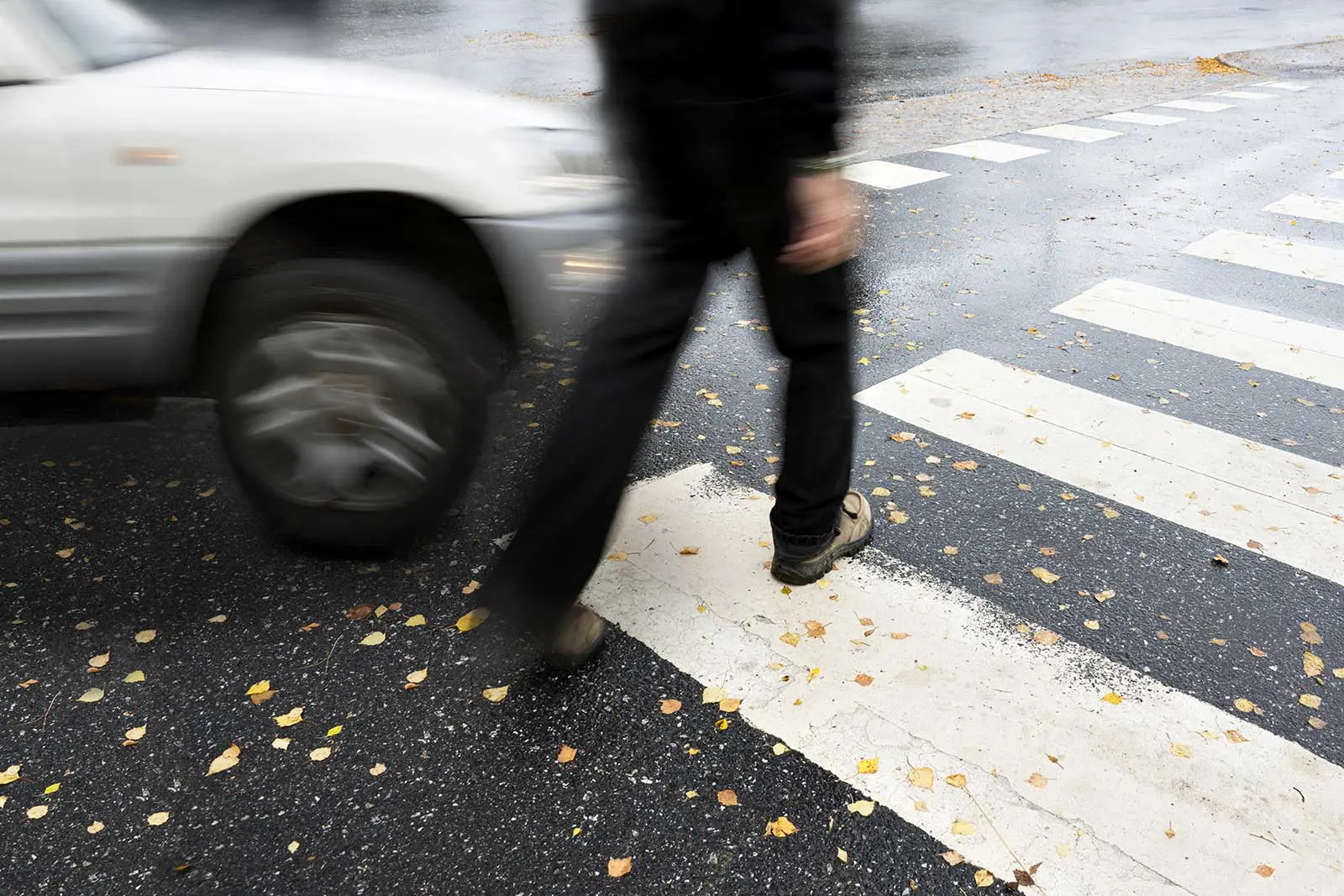
Almost every pedestrian case turns on the same argument: that you stepped out, or crossed where you shouldn't have, or weren't paying attention. A 2026 change to New York law made that argument far more dangerous than it used to be.
Attorney Jordan Stern handles your case personally, from the first call through the resolution. He has represented injured New Yorkers for over 30 years, across Nassau and Suffolk County, from the firm's office in Freeport.
Free consultation. No fee unless we recover money for you.
Who pays my medical bills?
The insurer of the vehicle that hit you — regardless of fault, and regardless of whether you own a car.
A pedestrian struck by a motor vehicle in New York is covered by that vehicle's no-fault policy, up to $50,000 in basic benefits for medical treatment and part of your lost earnings. The application is generally due within 30 days of the accident.
(The rule differs if you were riding on a bus when you were hurt — there, the claim generally starts with your own auto policy. Struck as a pedestrian, it starts with the vehicle that hit you.)
There is a practical problem here that catches people. You often do not know who the driver was insured by, and you may have been taken away by ambulance before anyone exchanged information. Get the police report number, and get help identifying the carrier quickly — the 30-day clock does not pause while you look.
What was the driver required to do?
The Vehicle and Traffic Law places more obligations on drivers than most people realize:
- Yield in crosswalks. Where signals are absent or not operating, a driver must yield to a pedestrian in a crosswalk, slowing or stopping if necessary. (VTL § 1151(a))
- Unmarked crosswalks count. An intersection without painted lines still has a crosswalk, and a pedestrian crossing there has the same protection as one between white stripes.
- No passing a stopped vehicle. When a car has stopped at a crosswalk to let someone cross, a driver approaching from behind may not overtake it. (VTL § 1151(c)) On multi-lane roads this is a common cause of the worst injuries.
- Driveways and sidewalks. A driver entering or emerging from a driveway, alley, or private road must yield to pedestrians on the sidewalk crossing it. (VTL § 1151-a)
- Due care everywhere. Drivers must exercise due care to avoid colliding with any pedestrian, anywhere on the roadway, and sound the horn when necessary. (VTL § 1146)
Turning drivers are a category of their own. A green light permits the turn; it does not permit turning into someone lawfully in the crosswalk.
The provision the defense will rely on sits in the same section. A pedestrian may not suddenly leave a curb or other place of safety and walk into the path of a vehicle so close that the driver cannot practically yield. (VTL § 1151(b)) Expect it to be quoted at you. It rarely resolves a case by itself, because it turns on how close the vehicle actually was and how fast it was travelling — questions where the physical evidence matters as much as anyone's account of what happened.
That evidence matters especially on the corridors where these collisions concentrate. Nassau County's deadliest roads for pedestrians in recent years have been Hempstead Turnpike, Sunrise Highway, Jericho Turnpike, Merrick Road, and Northern Boulevard — wide, fast roads running past shops, bus stops, and schools, with crosswalks spaced far enough apart to make mid-block crossing routine.
What if I wasn't in a crosswalk?
You may still have a claim, but this is where the case will be fought.
New York does require a pedestrian crossing outside a crosswalk to yield to vehicles. (VTL § 1152) Crossing mid-block, or against a signal, gives the defense something to work with. What it does not do is relieve the driver of the duty to exercise due care. A speeding or distracted driver who strikes someone crossing mid-block can still bear most of the responsibility.
Why this matters more than it used to. A 2026 amendment created an exception to New York's comparative fault rule for personal injury actions subject to the no-fault law — which is what a pedestrian's claim against a driver generally is. Previously, a pedestrian found partly at fault simply recovered less: 40% at fault meant 60% of the damages. Under the exception, if your share of the fault is greater than that of the party you are suing — or their combined share, where more than one is sued — you recover nothing from that party — not pain and suffering, and not the economic losses no-fault does not cover. The driver's no-fault benefits still pay your medical bills; that part does not depend on fault. (CPLR § 1411(b)) Fault is also decided first, before a jury ever considers the injuries.
So an argument that once cost a percentage can now end the case. That makes the physical evidence — the point of impact, the vehicle damage, sight lines, signal timing, nearby camera footage — decisive rather than merely helpful. It also has a short shelf life.
One qualification worth asking about: the rule applies to cases begun on or after it took effect in late May 2026. A claim already in suit before then may still be governed by the older rule.
Do I have to prove a "serious injury"?
Yes. Because the striking vehicle's no-fault coverage applies to you, recovering for pain and suffering requires meeting New York's serious injury threshold. (Insurance Law § 5102(d)) The 2026 amendments removed one of the categories claimants most often relied on and pushed the standard toward objective medical proof, so consistent treatment and a complete medical record matter more than they did two years ago.
What if the driver fled, or had no insurance?
There is still a path, and which one depends on whether anyone in your household owns a car.
If you or a resident relative has an auto policy, its uninsured motorist coverage may respond — that coverage is built into every New York auto policy. If nobody in the household owns a vehicle, which is often the case for someone injured on foot, a claim through MVAIC may be the only route. Both carry early notice requirements, and a hit-and-run should be reported to police right away.
How long do I have?
Three years for most claims, two years for a wrongful death claim. If a government vehicle struck you — a bus, a sanitation truck, a municipal vehicle — or a dangerous condition on public property contributed, a notice of claim is generally due within 90 days.
Struck while walking on Long Island?
Speak with Jordan Stern directly. The consultation is free, and there is no fee unless we recover.
Common questions
You may still have a claim — see the section above on crossing outside a crosswalk. It gives the defense something to work with, but it doesn't relieve the driver of the duty to exercise due care.
Private parking areas aren't governed by the same crosswalk statutes as public roads, but property owners and drivers still owe a general duty of care to pedestrians. Worth having the specifics looked into.
Yes. The police report, witnesses, and any available surveillance footage become especially important in that situation — which is another reason to call promptly, while that evidence still exists.
That's not unusual on its own. Having an attorney present the actual physical evidence — sight lines, signal timing, point of impact — often changes an insurer's initial position.
Speak with Jordan Stern
Struck by a vehicle anywhere on Long Island? The consultation is free and the conversation is confidential.
Stern & Stern · 49 West Merrick Road, Freeport, NY 11520
516-634-0345 · jstern@jordansternlaw.com · Se habla español
Been in an accident? Let's talk today.
Free consultation. No fee unless we recover for you.
Call 516-634-0345