
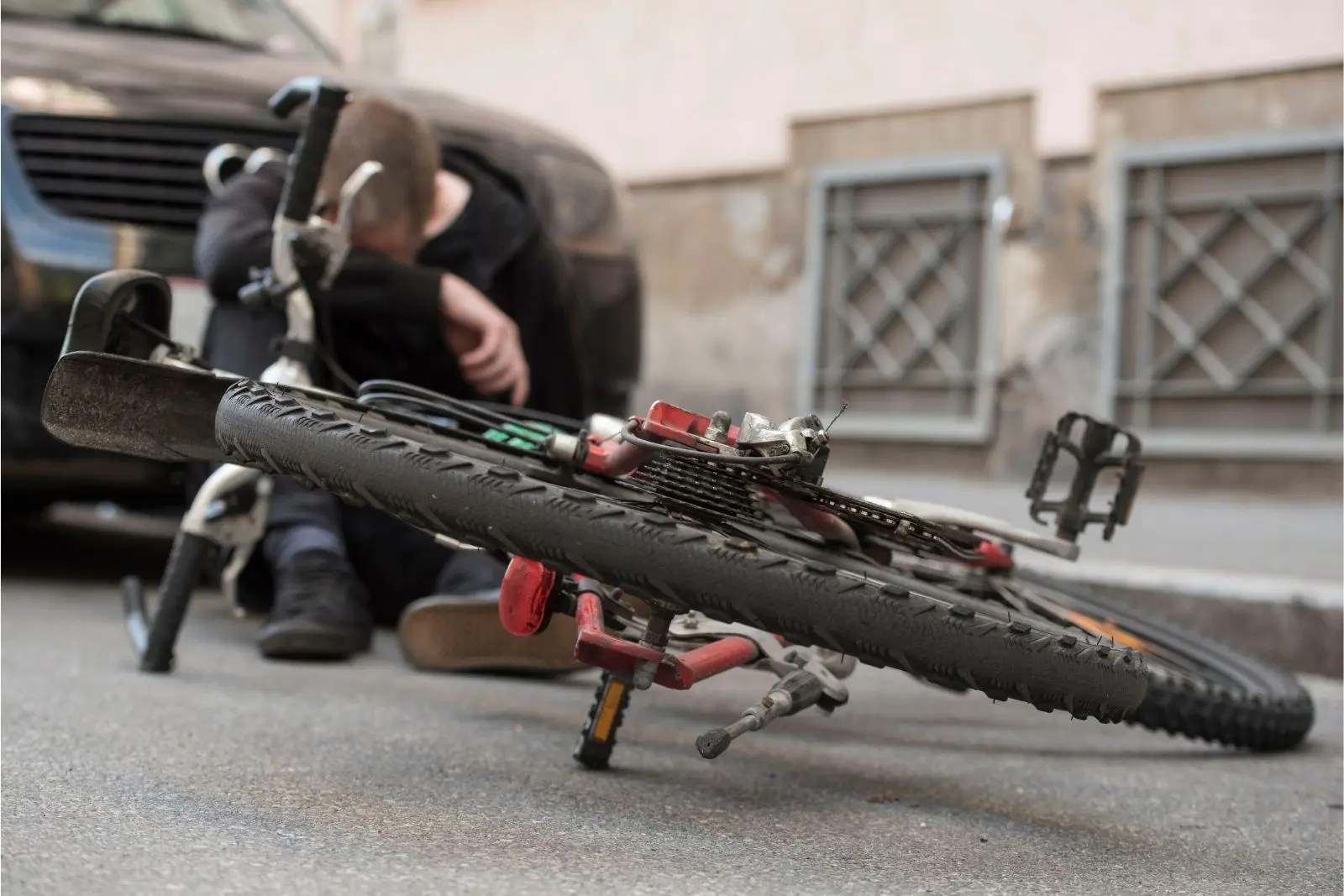
A driver who hits a cyclist almost always says the same thing: the rider came out of nowhere. Under a change to New York law that took effect in 2026, how that argument lands now matters more than it ever has.
Attorney Jordan Stern handles your case personally, from the first call through the resolution. He has represented injured New Yorkers for over 30 years, across Nassau and Suffolk County, from the firm's office in Freeport.
Free consultation. No fee unless we recover money for you.
Who pays my medical bills?
The driver's insurer — through no-fault, and regardless of who was at fault.
A cyclist struck by a motor vehicle in New York is covered by that vehicle's no-fault policy, up to $50,000 in basic benefits for treatment and part of your lost earnings. The claim is filed with the insurer of the car that hit you, not with any policy of your own, and the application is generally due within 30 days of the crash.
Most riders have no idea this coverage exists. Missing the 30-day window can mean paying for your own treatment while the rest of the claim plays out.
Why fault now decides everything
New York changed its comparative negligence rule in 2026 for claims involving motor vehicles.
The old rule reduced a claimant's recovery by their share of the blame — a rider 30% at fault still collected 70%. A 2026 amendment created an exception for personal injury actions subject to the no-fault law, which is what a cyclist's claim against a driver generally is. In those cases, if your share of the fault is greater than that of the party you are suing — or their combined share, where more than one is sued — you recover nothing from that party — not pain and suffering, and not the economic losses no-fault does not cover. Your own no-fault benefits are unaffected; those are paid regardless of fault. (CPLR § 1411(b)) A jury also decides fault first, before it ever considers your injuries.
For cyclists this is a significant shift, because fault is contested in almost every one of these cases. The rider was in the wrong part of the lane. The rider had no lights. The rider should have seen the door opening. Arguments that used to trim a recovery can now end it.
Which means the evidence that establishes what actually happened — the position of the bike and the vehicle, the damage patterns, nearby camera footage, witnesses — has become the whole case. It also has a short shelf life.
One qualification worth asking about: the rule applies to cases begun on or after it took effect in late May 2026. If your claim was already in suit before then, the older and more forgiving rule may still govern it.
What the driver was required to do
Cyclists are frequently blamed for collisions where the Vehicle and Traffic Law placed the duty on the driver:
- Due care. Drivers must exercise due care to avoid colliding with a bicyclist. (VTL § 1146)
- Safe passing. A motorist overtaking a cyclist must pass on the left at a safe distance. (VTL § 1122-a)
- Dooring. No one may open a car door on the traffic side until it is reasonably safe to do so. Where a door is opened into a rider's path, the person who opened it may be liable for the resulting injuries. (VTL § 1214)
Right hooks, bike lanes blocked by parked vehicles, and drivers turning across a rider's path all follow the same pattern: the maneuver was the driver's, and the rule was the driver's to follow.
What if I wasn't wearing a helmet?
New York requires helmets only for riders under 14. (VTL § 1238) There is no adult helmet requirement in this state, so the absence of one is not a violation of any law.
Expect the argument anyway — that a helmet would have reduced a head injury. It reaches head injuries only. It says nothing about a broken collarbone, a wrist fracture, or road rash.
Where the rider was under 14, the statute answers the argument itself: failure to comply with the helmet requirement does not constitute contributory negligence or assumption of risk, and does not bar a claim. (VTL § 1238(7)) That is worth raising early in any case involving an injured child.
The same goes for equipment. New York requires a white headlight, a red or amber taillight, and reflectors from half an hour after sunset to half an hour before sunrise, plus a bell or other audible signal at all times. (VTL § 1236) Riding without them can be argued as part of your share of the fault — which, under the new rule, is exactly why it should not go unanswered.
Do I have to prove a "serious injury"?
Yes, and this is where cyclists and motorcyclists part company.
Because you are covered by the striking vehicle's no-fault policy, you are a covered person under New York's no-fault law — which means recovering for pain and suffering requires meeting the serious injury threshold. (Insurance Law § 5102(d)) Motorcyclists, who get no no-fault benefits, face no such requirement.
The 2026 amendments also removed one of the categories riders most often relied on and pushed the threshold toward objective medical proof. Consistent treatment and a complete medical record matter more now than they did two years ago.
How long do I have?
Three years for most claims, and two years for a wrongful death claim. If a government vehicle was involved, or a dangerous road condition on public property contributed, a notice of claim may be due within 90 days.
Struck while riding on Long Island?
Speak with Jordan Stern directly. The consultation is free, and there is no fee unless we recover.
Common questions
New York regulates e-bikes somewhat differently depending on their class and speed. The core protections described above — no-fault coverage and the driver's duty of care — generally extend to e-bike riders struck by a motor vehicle, but coverage can depend on the bike's classification and how the collision occurred, so the policy and facts should be reviewed promptly.
Local law on sidewalk riding varies by municipality. Riding somewhere not legally permitted could be raised as a comparative fault factor, but it doesn't bar a claim outright.
That becomes a comparative fault question under the 2026 rule described above — which is exactly why the physical evidence matters as much as it does.
Property damage to the bike is generally a separate claim from the injury claim, typically pursued through the driver's property damage liability coverage.
Speak with Jordan Stern
Hit while riding anywhere on Long Island? The consultation is free and the conversation is confidential.
Stern & Stern · 49 West Merrick Road, Freeport, NY 11520
516-634-0345 · jstern@jordansternlaw.com · Se habla español
Been in an accident? Let's talk today.
Free consultation. No fee unless we recover for you.
Call 516-634-0345