
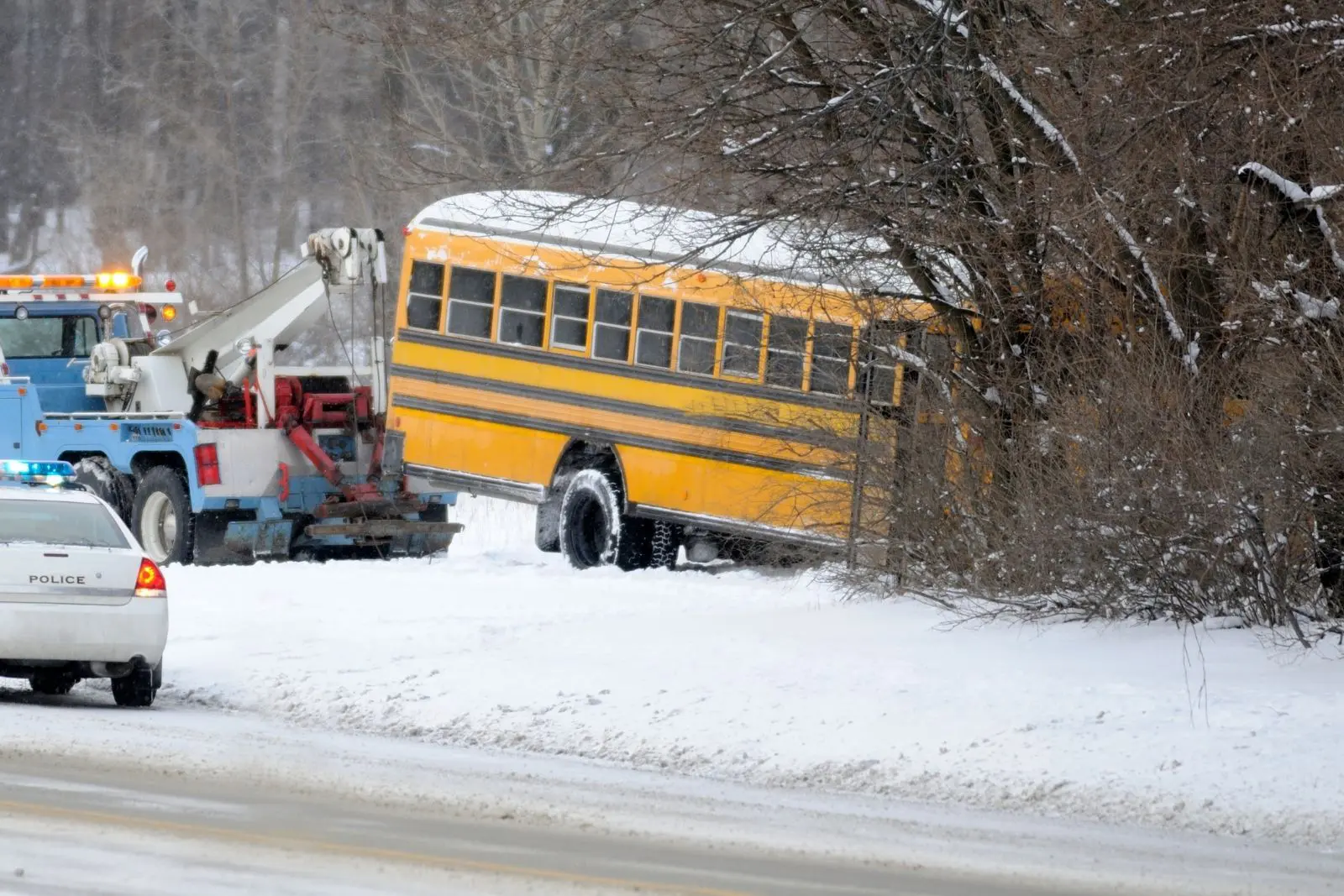
If a public bus or a school bus was involved, a deadline is already running — and it may be as short as 90 days. That is the reason to make one phone call before anything else.
Attorney Jordan Stern handles your case personally, from the first call through the resolution. He has represented injured New Yorkers for over 30 years, across Nassau and Suffolk County, from the firm's office in Freeport.
Free consultation. No fee unless we recover money for you.
Who is the claim actually against?
Rarely just the driver, and the answer decides which deadline applies.
NICE Bus is Nassau County's system, operated under contract by a private company, so a claim may involve the county, the contracted operator, or both — which one depends on the ownership, the contract, and the statutory status of each. Suffolk County Transit also uses contracted operators.
School buses may belong to the district or to a private contractor it hired. If the district is involved, government deadlines apply; if a private company operated the bus, it is treated like any other business — a distinction that can decide whether a family still has a case.
Charter, coach, and shuttle operators are private companies with commercial insurance and no notice requirement. The same is true of rideshare vehicles, which follow a different set of rules again.
How long do I have?
If a public entity is involved, generally 90 days to file a notice of claim. (A separate rule requires at least 30 days to pass after the notice is served before a suit is started, giving the entity a chance to investigate — that is a waiting period, not a second deadline.) The municipality can then require you to sit for a sworn hearing before suit, and the lawsuit itself must usually be brought within one year and 90 days.
Against a purely private bus company, the ordinary three-year period applies and no notice of claim is required.
This is the whole reason to call immediately. Ninety days sounds like a long time while someone is still in treatment, and it is not.
My child was hurt — doesn't being a minor extend that?
Not the part that matters most, and this catches families constantly.
New York does extend the time a child has to bring certain claims. It does not extend the 90-day notice of claim against a school district or municipality. That clock runs from the date of the accident regardless of the child's age, and a parent has to file within it. Courts can permit a late filing in some circumstances, but permission is never guaranteed.
What if a bus hit me?
Many bus claims come from outside the bus — pedestrians, cyclists, and drivers struck by a bus turning or pulling from a stop. Everything above about deadlines and defendants applies to you too.
School bus stops carry an extra rule. Traffic in both directions must stop for a school bus with red lights flashing, including on a divided highway, and stay stopped until the bus moves or the driver waves you on. The statute also binds the bus driver, who must keep the bus halted with the reds on until children have crossed or are at least fifteen feet away and off the road. (VTL § 1174)
Because that is a state statute imposing a specific duty, a violation is treated far more seriously than breaking a local code — it can go a long way toward establishing negligence on its own.
Who pays my medical bills?
Not the bus company, in most cases — and this surprises nearly everyone.
New York's no-fault law provides that a person injured on a bus or school bus claims benefits through their own auto insurer, or a resident relative's policy. Only if there is no auto policy in the household does the bus operator's coverage step in. So if you own a car, the claim starts with your own insurer even though your car was nowhere near the crash. The application is generally due within 30 days.
(This priority rule is specific to being on the bus. If a bus struck you while walking or cycling, the claim generally starts with the bus's insurer instead.)
No-fault does not pay for pain and suffering. That is a separate claim against whoever was at fault, and it requires meeting New York's serious injury threshold. (Insurance Law § 5102(d))
I fell when the bus lurched. Is that a case?
Possibly, though this is the one area where New York sets a higher bar.
For a fall caused by the movement of a bus, the jerk or lurch has to have been unusual and violent — of a different character than the ordinary jolts of bus travel. Saying it felt violent is not enough by itself; there has to be objective support, such as the force of what happened to you or to other passengers. (Urquhart v. New York City Transit Authority)
The flip side helps: when a carrier asks the court to dismiss, it carries the burden of showing the movement was not unusual and violent.
What if they say it was partly my fault?
Worth knowing, because the rule changed in 2026.
A 2026 amendment created an exception to New York's comparative fault rule for personal injury actions subject to the no-fault law. In those cases, a claimant whose share of the fault is greater than that of the party sued — or, where more than one is sued, greater than their combined share — recovers nothing from that party — not pain and suffering, and not economic losses beyond what no-fault covers — where previously the recovery was simply reduced. No-fault benefits themselves are unaffected. (CPLR § 1411(b), effective May 29, 2026) Fault is also decided first, before a jury considers the injuries at all.
Sharing some of the blame still does not bar a claim. But the argument that a passenger was standing when they should have been seated, or stepped out from in front of the bus, has more riding on it than it once did. Which is another reason the video matters.
What about the video?
Buses typically carry several onboard cameras, and there is often street or business footage as well. It runs on a limited cycle and can be gone before anyone asks, so a written demand to preserve it needs to go out early.
Carriers rely on that footage themselves, and it frequently decides these cases — which is why it should be obtained and reviewed by your own attorney, not left to the other side.
A public bus or school bus claim may carry a 90-day deadline.
Speak with Jordan Stern directly. The consultation is free, and there is no fee unless we recover.
Common questions
The same duty-of-care principles that apply while seated onboard generally extend to boarding and alighting. Everything above about deadlines and defendants still applies.
Video is valuable but rarely the only evidence. Driver logs, maintenance records, the incident report, and witness statements all still matter, and a preservation request should go out for all of it early.
Yes. A purely private operator is treated like any other business — the ordinary three-year period applies, and no notice of claim is required, unlike a claim against NICE Bus, Suffolk Transit, or a school district.
Your claim generally proceeds like any other motor vehicle collision, with the added step of identifying which entity operates and is responsible for the bus.
Speak with Jordan Stern
Injured on or by a bus anywhere on Long Island? The consultation is free, and if a public entity is involved the deadline is already running.
Stern & Stern · 49 West Merrick Road, Freeport, NY 11520
516-634-0345 · jstern@jordansternlaw.com · Se habla español
Been in an accident? Let's talk today.
Free consultation. No fee unless we recover for you.
Call 516-634-0345