
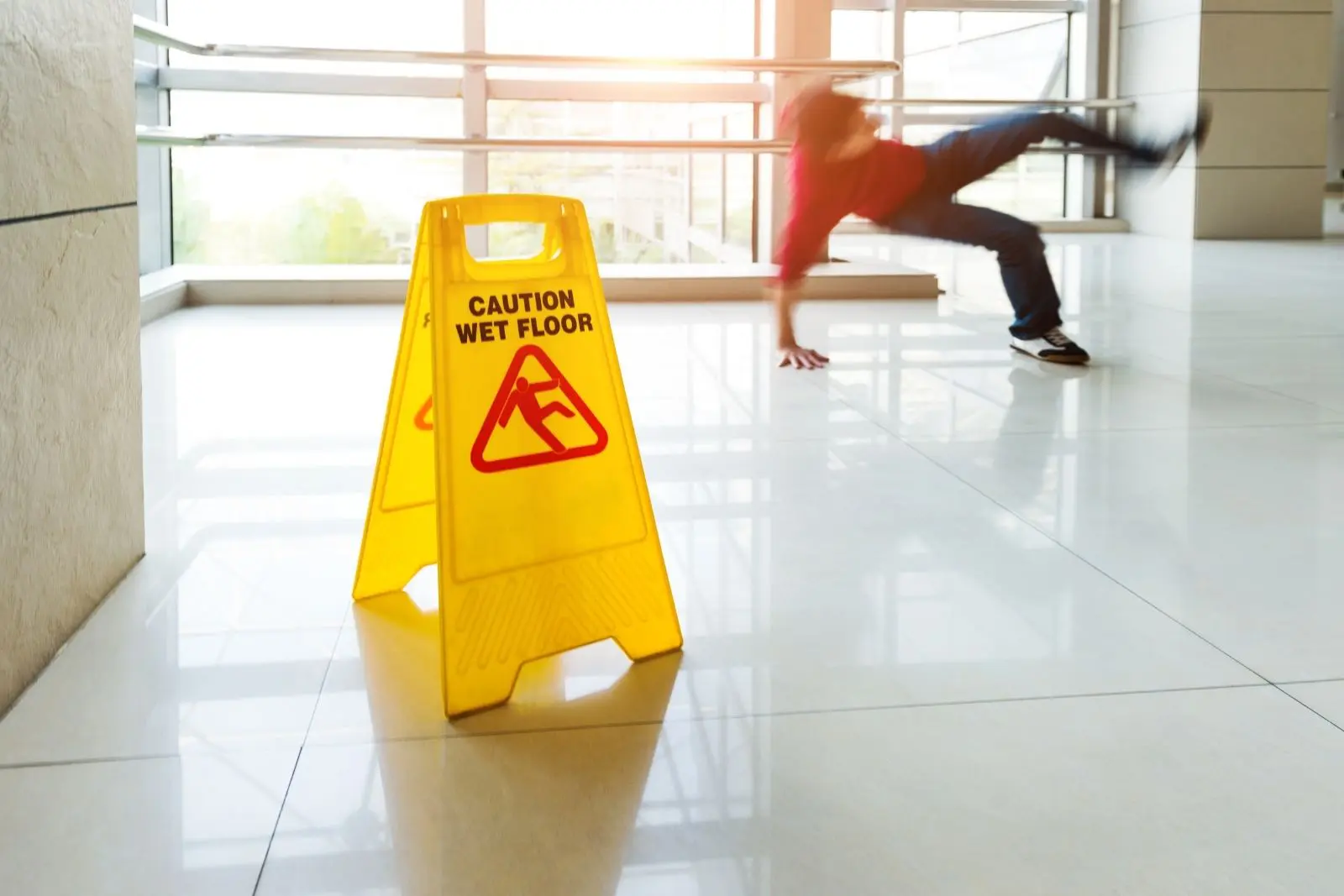
Whether you have a case rarely depends on how badly you were hurt. It depends on what the property owner knew, when they knew it, and what their own records show — which is why these cases are won or lost early.
Attorney Jordan Stern handles your case personally, from the first call through the resolution. He has handled premises liability claims for over 30 years, across Nassau and Suffolk County, from the firm's office in Freeport.
Free consultation. No fee unless we recover money for you.
What do I have to prove?
Falling on someone's property does not by itself make them responsible. The claim generally has to show one of three things:
- They created the hazard — an employee mopped and left no sign, a display spilled into the aisle.
- They knew about it — a customer reported the spill, a tenant complained about the broken step.
- They should have known. New York's highest court requires that the hazard was visible and apparent, and that it sat there long enough for the owner to find and fix it. (Gordon v. American Museum of Natural History)
That third route is where most of these cases are fought — and where they are frequently won. If the owner asks the court to dismiss the case, they cannot do it by describing their general cleaning routine. They have to show when that specific area was actually inspected before you fell. Many cannot.
There is also a fourth route, and it works differently from a one-time spill. Where the hazard is one that keeps coming back — a chronic leak, a worn stair, an icy downspout — evidence of the ongoing problem can establish that the owner knew, without proving how long this particular hazard had been there.
What if I fell on a staircase?
Stairways are one of the few places where the building itself becomes the evidence.
Building codes require the steps in a flight to be uniform: the tallest and shortest riser, and the deepest and shallowest tread, generally cannot differ by more than three-eighths of an inch. That tolerance exists because people climb stairs by rhythm, not by looking. A single step slightly out of line with the others is enough to break stride, and it is a common cause of serious falls.
Maximum riser heights and minimum tread depths vary with the type of building and the code in force when it was built, so these cases usually require precise measurement. The same is true of handrails, which must be present, graspable, and properly mounted.
A code violation does not win the case automatically — in New York it is treated as evidence of negligence rather than automatic liability — but it is powerful evidence, and it is objective in a way that most fall cases never are. We arrange the inspection, and the sooner that happens the better, because a staircase that gets repaired takes the proof with it.
How long does surveillance video last?
Often only days or weeks before it records over itself automatically.
Video is usually the most important evidence in a fall case, and a letter demanding that it be preserved has to go out quickly. The same is true of sweep logs, inspection sheets, the incident report a manager filled out, and prior complaints. Once those are gone, how long the hazard sat there becomes your word against a manager's memory.
If you have just fallen: report it before you leave, write down the manager's name, photograph the scene yourself from several angles, get contact information for witnesses, and see a doctor.
Falls caused by broken or uneven pavement rather than a slippery surface are covered on our trip and fall page.
Can I recover if I slipped on ice?
Often, yes. Owners remain responsible for ice that was already there before the latest storm, for refreeze from melting snow, and for clearing done so badly it makes conditions worse — plowing snow where it melts across a walkway, for example.
What they are not required to do is clear while a storm is still falling, or in the first reasonable stretch afterward. Certified weather records for that date and location are often central to the question, along with the plowing and salting contracts, which can identify a snow removal company that shares responsibility.
What if I was partly at fault?
New York reduces your recovery by your share of the blame rather than eliminating the claim. (CPLR § 1411) The 2026 change to that rule applies to motor vehicle claims, not to premises cases like this one. Being distracted, or carrying groceries, is not a defense for the property owner. Neither is the argument that the hazard was in plain sight.
Who pays my medical bills?
No-fault covers car accidents, not falls, so your health insurance generally carries the treatment while the claim proceeds. Those costs are then part of what the claim seeks to recover.
How long do I have?
Three years for most claims against a private owner. If you fell on government property — a school, a village lot, a county building — a notice of claim is generally due within 90 days, and that deadline catches people who had no idea it applied to them. If you are anywhere near it, call today rather than next week.
The video that decides these cases doesn't last long.
Speak with Jordan Stern directly. The consultation is free, and there is no fee unless we recover.
Common questions
That's often the central question in these cases, not a reason to assume there's no claim. Inspection logs, sweep sheets, and prior complaints are what typically answer it — which is exactly why they need to be requested and preserved quickly, before they're gone.
Most retail and commercial properties have cameras even where none are visible. A preservation letter should go out promptly regardless, since footage is often overwritten automatically within days.
An incident report acknowledgment is not the same as a release of your claim. It's still worth having whatever you signed reviewed before assuming it changes anything.
Footwear may come up as a comparative fault argument, but it doesn't bar a claim on its own. New York reduces recovery by your share of the blame rather than eliminating it — the same rule described above.
Speak with Jordan Stern
Injured in a fall anywhere on Long Island? The consultation is free and the conversation is confidential.
Stern & Stern · 49 West Merrick Road, Freeport, NY 11520
516-634-0345 · jstern@jordansternlaw.com · Se habla español
Been in an accident? Let's talk today.
Free consultation. No fee unless we recover for you.
Call 516-634-0345